Showing posts with label science. Show all posts

Wednesday, April 12, 2017

Research Paper: A Solution to Municipal Waste Accumulation

Emily Gonzalez
Tucker
Neto
N.E.W. Core

A Solution to Municipal Waste Accumulation
The United States’s predictions for the amount of landfill disposal rates per year was greatly underestimated in the year of 2012. The prediction of 262 million tonnes of landfill waste was off by 140 million tonnes (Estimates of solid waste disposal rates and reduction targets for landfill gas emissions Powell, Townsend, Zimmerman). The rapid accumulation of compostable and recyclable waste in landfills resulting from the disorganization of waste is causing other landfill waste to produce greenhouse gases and take longer to decompose; however, if a receptacle that could automatically organize waste was used in public spaces, it would significantly reduce the manual labor needed to organize waste.
Recyclable plastics and food waste are taking up space in landfills, producing methane emissions that warm the atmosphere. According to the Environmental Protection Agency, municipal solid waste (MSW), or anything found in a landfill, has been found to be 30% paper and 13% plastics (Environmental Protection Agency). This data points to how landfills are being built to towering heights. Both of these materials can be recycled, but since plastic regulations are different depending on the area, consumers do not know what to do with their plastics and there are several misconceptions about recycling paper. Even when people do know what to do with their waste, they may still not dispose of it properly. Dr. Jean C. Buzby, Chief of the Diet, Safety, and Health Economics Branch Economic Research Service at the USDA reports that in the United States in 2010, around 19% of food lost at the consumer level were fruit and 22% vegetables. This adds up to 12.5 billion pounds fruit and 18.2 billion pounds of vegetables lost in 2010(Overview of Food Loss in the United States). All of this produce could be composted into fertilizer and reused again. Instead, it is being thrown into the garbage so that it resides with other MSW. These billions of pounds of food, when crushed under other billions of pounds of paper, plastic and other waste, produce methane. The University of San Diego’s website, CalSpace, explains that methane is a greenhouse gas, that is produced under certain conditions when there is not sufficient oxygen. Just like carbon dioxide, it affects the warming of the atmosphere, but unlike the effects of carbon, a decrease in methane would have immediate effects(CalSpace). Since there is not a lot of oxygen under other waste, instead of food just decomposing, it creates methane. If people were able to immediately reduce the amount of food that went to landfills, this would have an immediate effect on the atmosphere. Landfills are full to the brim with paper, plastics and food because consumers choose to throw away their trash instead of any alternatives as it is the most convenient option.
Even when consumers make conscious choices about where their waste goes, they may end up throwing away waste into the wrong compartments, leading to unnecessary MSW.  Many consumers are unsure what to do with their plastics, which is clear from the statistic that “9.5 percent of plastics were recycled in 2013” (Environmental Protection Agency). There are many misconceptions about which materials are recyclable. The reality is that it varies by area, so the consumer would have to conduct research to find out what material their product is made out of and whether they should recycle it. Most consumers do not have the time to research everything that they throw away, so they throw it into the trash bin and it  ends up in a landfill.
Source: Biocycle
Article: State of Composting in the U.S.

The pie chart above displays the percentage of different composting facilities in the United States.  The majority of composting facilities recorded were for yard trimmings, while only 7% were food scraps. Many people are now aware that composting is an option, but they still do not compost food. Composting facilities for yard trimmings make it easy for people to put their yard waste in a bucket and not have to worry about it. They do not have this luxury with food scraps, which need to either be thrown into the trash or composted manually. MSW will continue to be on the rise as long as people do not understand that recycling plastics and composting their food is an option.
Since the majority of people are not composting or recycling their waste, it all collects in million tons of landfill waste which emits methane when kept under pressure, or releases toxic chemicals in the air when burned. After calculating the amount of waste in different landfills the EPA found that in the United States “about 258 million tons of MSW were generated. (...) over 33 million tons of MSW were combusted with energy recovery and 136 million tons were landfilled”.  These million tons of waste take up space and wreak havoc on the atmosphere. More and more municipal landfills need to be created to store all of this MSW. Areas that become landfills cannot be used for much else, since the waste permeates the area. Once waste ends up in a landfill, it has very few uses. It is either left to decompose and create methane under high amounts of pressure, or it is incinerated to make more space. The Environmental Protection Agency’s findings report that municipal landfills are one of the leading contributors to methane emissions, producing 89,650,353 metric tons. Since methane is a greenhouse gas, these 89 million metric tons are contributing to global warming. If food waste was composted, it would decompose normally. When it is packed in landfills under tons of pressure, it creates methane. This means that if food waste in landfills was immediately reduced, it would have an immediate effect on climate change. Many people have been blaming other contributors such as cars and factories, but food waste is another often overlooked contributor. One of the solutions to the constant growth and need of landfills is to incinerate waste. This seems effective at first glance, but can actually be more harmful to the environment. The organization Ecocycle, which looks to make communities have ‘zero waste’ or no waste, published a paper discussing how waste-to-energy is more harmful than most conceive. Multiple studies have shown that it releases harmful chemicals such as volatile organic compounds (VOC) and greenhouse gases, among other materials. These can be hazardous for respiratory health, development, and be more likely to cause cancer. Even if all waste was burnt, 25% of it would still be ashes (Waste of Energy). This defeats many of the purposes of using waste-to-energy. It still creates greenhouse gases just like methane and can actually release more harmful materials into the atmosphere. It makes it so that instead of this waste staying in landfills, it resides in the air. It doesn’t fix the problem, it just changes the waste into a different form of matter. Even so, since the ashes need to be buried, people still have to make space for them. Incineration leads to more health and environmental problems than most people are led to believe, making it an ineffective solution. Overall, once waste leaves the garbage can, it is left to rot and spoil, decomposing and creating methane. Many attempts to rid of municipal waste have led to more problems, but if this waste was recovered in its early stages, it could be redirected to recycling and composting facilities to be more effective in helping the environment.
A solution for this problem is a disposal bucket that automatically manages waste. The magazine, The Economist reports that companies have begun in 2015 to largely invest into, “recycling infrastructure. Walmart, Coca-Cola and eight other big companies have created a $100m Closed Loop Fund, which offers zero- and low-interest loans to cities and recycling companies for everything from better bins to more efficient sorting plants” (Recycling in America: In the Bin, The Economist). Since recycling has to do more with small scale municipal landfills, local power has the most effect on recycling. This is why these large companies have invested into cities and recycling management. Even these large companies know that recycling would be the best option for them because it costs less to produce recycled materials, but cities do not have the sufficient funds to invest in recycling programs. Every city has different policies and different amounts of available workforce. Even if there are more recycling programs, people at the consumer level may still throw their waste in the wrong compartment, wasting billions of pieces of plastic. Not to mention that recycling does not include the tons of food waste put in municipal waste daily.  The solution that has been proposed is a waste disposal container that automatically sorts waste depending on the molecular composition of the material. The bucket would have three compartments: one that washes recycling, one for compostable food waste and one for MCW. The container for food waste would automatically spin every few hours, keeping the new waste at the bottom and the soil at the top. The consumer will put their waste on a platform with a molecular sensor. Depending on the molecular composition, it will light up and open the corresponding compartment. The effects of this solution would be gradual, yet effective. Less workers would be needed to sort through the different types of waste and the consumer would not have to think at all. This would make more types of plastic recycled because people will know if it is recyclable and more food would be composted because of the option there. Money that is used to currently invest in recycling programs and regular bucket could be used to fund this solution since the first places this would be installed would be public areas, such as parks, beaches and schools. Just having the option of composting would reduce food waste by large amounts, since that is not a current option in public areas. The bucket would require little to no management, other than being emptied once every week or so and repaired if it was damaged. Even people with no experience of recycling or composting could easily use this solution. Bringing it all together, an effective solution to reduce the amount of food waste and recyclable materials in municipal landfills is an automatic waste management on a small scale. The problem starts at the consumer level, therefore, that is where this solution lies.
The solution provided could make a substantial difference in the enourmous amounts of food and recyclable waste thrown into municipal landfills each year. Reducing the amount of food and recyclables in landfills can reduce metric tons of methane emissions and the need to burn waste. Other methods to reduce the amount of waste often look at the problem as soon as it starts off from the landfill, or assume that people are aware of recycling and composting as options. With this solution, people will not have to be aware of the problem or solutions as a whole, but can still make an unconscious effort to defeat the growth municipal landfills.
Works Cited
"The Greenhouse Gases." The Greenhouse Gases. U.C. Davis, n.d. Web. 04 Apr. 2017
EPA. Environmental Protection Agency, n.d. Web. 04 Apr. 2017.
Gunders, Dana. "Wasted: How America Is Losing Up to 40 Percent of Its Food from Farm to Fork to Landfill." NRDC. NRDC, 15 Dec. 2016. Web. 04 Apr. 2017.
"Reduce, Reuse, Recycle." EPA. Environmental Protection Agency, 04 Jan. 2017. Web. 04 Apr.
2017.
Dr. Jean Buzby, “Overview of Food Loss in the United States”. U.C. Davis. 2014. Web. 04 Apr.
2017.
"In the Bin." The Economist. The Economist Newspaper, 22 Apr. 2015. Web. 04 Apr. 2017.

Wednesday, February 1, 2017

STEM Design Challenge

In our science class, we were given a block to design and create a water slide for a small toy. All of our groups had to use teamwork, their understandings of physics and design and be able to work under pressure. This was the design our team came up with.


If we were to do this again, we wouldn't use the easel and instead use one of the larger pieces of wood to hold up our slide. We would also make it longer or taller, since the main point of the challenge was to make the longest/tallest slide. We would also cut the top of the cups, since the toy got stuck in slide. All of the teams had a fun time doing this, and learned from the experience, even if their designs didn't work.

Thursday, January 19, 2017

Depression in Young People

These are notes taken about a webinar by the National Institute of Mental Health. This is a review of everything talked about during the webinar. 

Why is there Depression?

Sadness and depression can be an evolutionary protection device from negative outcomes. It may be a physic pain or a way of changing one's environment. There may be positivity to negativity. It may be a protection from infections or how we focus on the past (an analytical rumination of thinking).

Is this sadness or depression? For about 3 weeks, a girl named Christina's mood is low, she spends her time alone. Her grades are lowering and she cannot concentrate. Her parents separated very recently.

Five of the following symptoms are present for two or more weeks:

Depressed mood for most of the day, or irritable mood, it has to be present most of the time
Markedly diminished interest or pleasure at all
Significant change in weight when not dieting or weight gain
Insomnia or Hypersomnia
Psychomotor agitation or retardation
Fatigue or loss of energy nearly every day
Feelings of worthlessness or excessive or inappropriate guilt (which may be delusional) nearly every day
Diminished ability to think or concentrate
Recurrent thoughts of death (not just fear of dying) recurrent suicidal ideation without a specific plan or an attempt or specific plan to commit suicide

The symptoms cause clinically significant distress or impairment in social, occupational, or other important areas of functioning

Prevalence

10-17% In adults
1-2% in pre-pubertal children
Adolescents with depression are 30% more likely to die of suicide
In its severe form, it affects 9% of adolescents
Second leading cause of people living with disability
More prevalent than other diseases, even cancer

Genes and Environment: Potential Causes

Genes: 30-50% of the liability to depression
Gene-environment correlation: e.g. Increased genetic liability for lifetime traumas
Gene-environment interaction: different genotypes respond to environmental variability in different ways

Ex. Christina's mother is diagnosed with depression during pregnancy. It may pass down to the child. Christina's father lives far away and sees her rarely. He drinks and his company went bankrupt. Since Christina shares genes with both of these people, she has a higher liability in having depression. They also experienced traumatic events, which may affect her more. But since they are correlated, they may end up working together passively or actively. Ex: Since Christina's mother is depressed, they may both become depressed since they share the same genes and experiences.

Dr Kendler used a study on identical and fraternal twins to see how much environment affects liability. Having a traumatic life event increases the chances dramatically. The lowest chances are the ones with genetics that don't react as strongly. The opposite leads to a higher chance of depression in the presence of a life event. So some people may have completely different reactions to the same event.

With the onset of puberty, girls are more likely to have depression than boys. There is a 1 to 2 ratio. It may have to do to with cognitive processing, greater exposure to psychological stressors, or hormonal mechanisms. Girls with an earlier start in their menstrual cycle are more likely to become depressed, it may be because of hormones, or a psychological stressor, or over exposure to other people, they feel uncomfortable around.

There is a debate on whether childhood depression correlates with adult depression, but adolescent depression has shown pathways to adult depression.
Anxiety: early on anxiety precedes depression
Alcohol: Probably an "internalising" way of handling depression
ODD/CD: The strongest predictors for later depression
Behaviour problems and depression are related
40% had disruptive behaviour in their childhood
Highest risk in girls
Youth with CD are twice more likely to have it
Irritable and disruptive behaviour are shown to be directly correlated. What we need to find out is how this transition starts and finding out who has depression and who doesn't.

Depression is a heterogeneous syndrome. It is useful to think of two abnormalities

-Negativity bias and missing the positive
It is more common for someone with anxiety or depression to misinterpret a neutral face as sad or angry.
-They will pick up what is negative in their environment
They will be more likely to miss the positive, such as a smile. A depressed person will relate a smile back to positive less than someone else. Anti-depressants work highly in these areas.
Motivation and reward processing
-Most people go after rewards and feel good when they get it
Anticipatory anhedonia: People with depression will not take the effort to get that reward
People will see this as lazy or a motivation problem, but with depression, it is more that the person can't see why this would be important
Ex: Christina used to dance, but she stopped because they are "no fun at all" She has stopped sending texts to her friends.
People with no processing in the longitudinal segment of the brain are more likely to be depressed in life; this is the segment of the brain that has reward processing.

Phycological and Medical Treatments

Christina's diagnosis was delayed for 18 months. Why?
Parents focused on irritability/oppositionality
Teachers focused on academic performance
She herself could not talk about it, except in terms such as "boring", "annoying" etc.
She was only diagnosed after she took her first overdose and then it became apparent that she had been "cutting" for a while.
It was still hard to explain to her parents the meaning of the problem
She herself was still perplexed

Awareness is key to diagnosis.
Screening is only appropriate in samples that are at high risk. Screening can range from single questions to a questionnaire. Diagnosis should also address the presence of manic symptoms, underlying medical causes (rare), risk assessment, such as past attempts of suicide and cases of depression. They shouldn't have access to guns or drugs.

Not all causes are changeable, such as environment or genes. You may be able to change the relationship between the mother and child or the father and child. Medication can have an effect on behaviour, feelings, and thoughts through the brain, but so does psychological treatments.

The first treatment is a reuptake in serotonin, fluoxetine, sertraline, citalopram
Psychological treatments such as interpersonal treatment or cognitive therapy

There haven't been any sign that one is better than the other. In mild cases, start with CBT/IPT
Some studies show that using them both may be the best
About 60% of young people respond to an antidepressant, however, 50% respond to placebo. This may be related to the severity of the depression, the higher the severity of the depression, the lower they affect to placebo.
The numbers needed to treat a person are 10 and the numbers needed to harm is 112. This is particularly important in the context of suicidality debate and the black box warning.

Thursday, December 8, 2016

A Glass of Water

Emily Gonzalez
Neto
Tucker
12/6/16


A Glass of Water

Eyes opened, light flooded into my eyes. The doors slammed into the wall, my eyes fluttering open with it. A foggy image of reality fell around me. I heard mumblings, they sounded like my mother, and the doctor. I reached my hand to wipe away at my puffy eyes. Even as I blinked, nothing seemed to stay in focus. I waddled a little while getting up, and the sounds of speech bounced through my ear, bouncing across the inside of my skull, falling down to my throat. My eyes heated up, I choked back my food. I breathed hard, hoping the others didn’t notice, then sat back.
My mom reached for my hand. I smiled. I still couldn’t see every line of her face, but I could feel the warmth in her hand. The doctor was still speaking. I managed to catch a few words, even if they were all just falling to my stomach. More treatments, a surgery. He said it wouldn’t be long before we got out of here. It cheered me up, very little. I could finally stop stealing away all of our money, my future, my life back at home. I could go home, to a warm bed with plush bears and pillows. I could get back to school work, something I’d never thought I’d say positively.
My heart beat a little faster. I noticed that the feeling wasn’t going away, I still felt as if two text books were being pushed against each of my ears, the bed was floating in the ocean, and clouds were over my eyes. I started to yawn, but almost gagged. I clenched my stomach. They looked at me, so I tried to say I was okay. I was trying to wrap my tongue around the words, but just signaled it with my hands. They went back to talking.
That’s when I noticed the glass of water next to me, from the night before. There was food, sure, but I didn’t want to put that in my stomach, it already had enough knots in it, I didn’t need more. The glass was out of reach, but if I got it the other day, I could get it now. I lifted my arm up, but my mom talked to me again. She pointed at the food, but I rolled my eyes and shook my head. I could tell my mom was stern, pointing at the food. I sighed and grabbed a fork, and my mom sighed before going back to talking about prices and insurance and the whatnot, something I wasn’t old enough to understand, or at least that’s what she told me when I asked about it. I kept on looking back at the glass. I put a roll in my mouth, which felt more like a sponge that took in all my built-up saliva. I sniffed and wiped away the tears my eyes kept on making.
Even if all I could focus on was a glass of water, it was something. My focus kept on going from my mom, to the doctor, to the background, to the window that led to the world I hadn’t seen in days, weeks now? How long had it been? Why, why couldn’t I remember...why wasn’t I speaking? Had something gone wrong, what was going on? I reached for breath. Heart beats pushed at my ears so hard my eyes were watering, there was bread at the back of my throat. I gasped for air.
My dry lips stung. I lifted my arm to grab the glass. No one saw. I pushed myself over, noticing my wobble, my eyes refocusing. I did it again, again, until I was sure the bread would spill out of my mouth any minute. I reached up to the glass. I put my hand around it. I put all my energy to move every finger, every bone, until they fit around. Wait, why was I overthinking this? It was just a glass? I took in a deep breath, letting a few tears fall. I took advantage that they still hadn’t seen. I pushed my palm against the glass, then pulled back. That’s when all my attention went into the glass. My fingers...they weren’t working. In a split second, I had lost control. The glass slipped, I felt the cold run through my fingers like silk. My heart stopped when I couldn’t feel it anymore, when gravity took its toll. The shattered glass punctured my inner ears, bursting my brain. The mosaic of a mess painted the floor. My tears weren’t distinguishable from the water.
That’s when they turned back. I jumped back. I held my head in my hands, warming them with wet tears. I couldn’t look at them. My mom moved closer, trying to comfort me, I pushed her back. The doctor called for someone to clean the mess. He tried to comfort me too, but I pushed him back too. I held my head in my hands again, trying to find comfort in the home that was my mind, my, my mind. The mind that couldn’t even lift a glass. Would I ever be able to lift one again?
When time died down my shock, when the glass was gone, and when the room was silent, I finally answered them. I pushed at my chest, trying to get the air to talk, “I-I w-was thirsty.”
They said they could have given it to me. I looked down at the ground, realizing that they thought I was upset at breaking the glass. They got me another glass. They were giving all their attention to me. Pins pierced the back of my neck as I looked up at them. Eyes watering, my back tingling, with a foggy mind and clouded eyes, and stomach that wouldn’t hold. I smiled. I even laughed.
“Don’t worry, it was just a glass of water…”


Works Cited

"Medulloblastoma." St. Jude Children's Research Hospital. N.p., n.d. Web. 07 Dec.                       2016.
"Cerebellum." Cerebellum Function, Anatomy & Definition | Body Maps. Healthline, 5 Mar. 2015. Web. 07 Dec. 2016.
Foundation, Brain Science. "Coping With Personality and Behavioral Changes." Coping With Personality & Behavioral Changes. Brain Science Foundation, 2003. Web. 07 Dec. 2016.


Monday, November 21, 2016

Iron Chef Competition


Today we watched the presentations of the other iron 'chef' group lab experiments. Each team had different items depending on what they picked. Each team had to come up with a hypothesis, a procedure, a purpose, and etc. Every two teams were competing with the same ingredients.

We started with the fresh strawberries groups.

Team 1: They used enzymes to digest down strawberries. They tested to see what kind of strawberry would digest the fastest. They dropped both conventional and organic strawberries in amylase, pectinase, and mixtures of the two. They put strawberries in beakers of water, pectinase, amylase and the mixture then measured the displacement. There were a couple of problems however, evaporation was greater in some beakers than others, the marks weren't precise enough, light got into the beakers to cause more evaporation, there weren't enough strawberries, some beakers were different sizes, the measuring tools weren't precise, there was even mold growth, and increased the displacement. Disregarding evaporation, there wasn't any difference in between conventional and organic digestion. They were originally testing to see how conventional and organic food would digest, but there was no visible difference.

vs.

Team 2: This team tested to see which grew more mold (betridus cinerea), conventional or organic strawberries. They made agar to put the strawberries in. They used regular agar and potato dextrin agar. They swabbed the strawberries, opened the petri dish and spread it across the agar. They kept the agar in the incubator for two weeks. Then they stained the petri dish so they could see the mold growth. They looked for gram negative and gram positive microbes in the dishes. Their timing was a bit off, their incubator got turned off for a day, they didn't have a strong microscope and they didn't always wear gloves. If they were to do it again they would wait longer for the fungus to grow.

(Team 2 Moved on to the next round!)

Pesticides

Team 1:  They tested different amount of pesticides to see which affected animal or plant cells more. They used yeast because it acts as an animal cell, they activated for about 10 to 15 minutes, then added sugar and pesticide once every two days for two weeks. The yeast with pesticide died, while the ones with pesticide stayed alive as they added the sugar. An error was that ants got into the classroom. Then they tested against basil to see if the pesticide affected plants. 3 had pesticide, and the one without pesticide. The ones with pesticide started drying out and the leaves started breaking off easily. The pesticide did affect the plants. It was the only one with ta positive increase, the rest had a decrease. They measured by height. The main purpose of the experiment was to see how pesticides affect the food people eat and the animal cells that humans have. The judge felt like there should have been more control groups, and show the change of height and not just the overall height.

vs.

Team 2: Their hypothesis was to see if organic or conventional grew more bacteria after having pesticide put on them. They made agar then got their two materials. They got organic chuck meat and conventional chuck meat and organic and non-organic apples. It lasted two weeks with a total of five collection days. Sometimes there was mold on the agar groups, sometimes there wasn't anything especially in the control groups. Their basic reason for this experiment was that conventional is usually covered in pesticides. Organic is not allowed to have more than .1% pesticide. The incubator was turned off for a day also. The organic chuck was the one that stunk up the room the most. Ants started coming into the room. They weren't able to check the dishes every day. The incubator overheated near the end of the experiment. If they were to do it again they would use more dishes so they had more groups to check for more growth. They would measure more and they would work in a more controlled environment.

(Team 1 Moved on to the next round! )

Sugars

Team 1: This group swabbed sugars to see how bacteria acts after being fed different sugars. The overarching goal was to relate the bacteria growth is like cell growth. They put a different sugar in each petri dish. They wanted to see which one promoted the most cell growth. First, they had to make the agar. They used agar tablets, a hot plate, distilled water, a beaker, and a heat protecting glove. They used bacteria from the back of phones and then observe how the bacteria grew with different sugars. They counted the amount of bacterial colonies and averaged out three counts, then averaged out all the times. They used honey, cane sugar, corn syrup and a control group.

vs.

Team 2: This team used the sugars to test for glucose levels in the human body. They picked out their human subjects. Every core day they would test and monitor blood. They pricked fingers to test blood. They started with a week to see their regular blood sugar level. Each week they tested out a different sugar, from cane sugar to honey to corn syrup. They then found the averages of the sugar. Honey had the highest increase in blood sugar levels. There were some holes in their data. If they were to do it again, they would do it for longer and with more people.

(Team 1  Moved on to the next round! )            

Corn

Team 1:  They began by talking about BPA. It is a chemical found in plastic containers and the inside of cans. BPA would be found in most of the ingredients the group was given. BPA is toxic and can hurt cells. They extracted BPA straight from a plastic water bottle. They worked with the A.P. Chem teacher to do this. BPA has a significant lower melting rate than plastic so they were able to melt out the BPA. They wanted to see differences in between the BPA cells and the control groups. They weren't able to get conclusive results but they learned a lot about how to make an experiment and how to make BPA. BPA is a toxic chemical and the group learned to avoid letting plastic melt that can have BPA because it can cause cancer and other diseases.

vs.

Team 2: They tested to see how bacteria grew on different types of corn. They learned how to use a microscope. Then they learned how to make their own agar. Then they learned how to count colonies electronically. They ran it through a program by masking the image then tracked the amount of colonies. They swabbed bacteria from surfaces then covered the corn with it. They took pictures of them every core day, a total of six days. There were some errors. The colony counting was messed up first. The petri dishes weren't sterilized. The incubator was turned off one day so that skewed the results. The incubator dried up the agar at one point. Frozen corn killed the most bacteria and the conventional corn gathers a lot of bacteria and grows the most. They consider frozen corn to be the best choice for people with autoimmune disorders and its better for the world so that they can eat healthier non-frozen food.

(Team 1  Moved on to the next round!)

Team 1: The first team put teeth into the different drinks. They saw how each of the teeth decayed and grew plaque in the different drinks.

Team 2: Our team, so check out this post to see more.

(Team 2 Moved on to the next round! Yay!)

And after one final round, the winner is the Corn team that melted BPA from plastic. Good job everybody!


Tuesday, November 15, 2016

Iron Chef Lab: Do Added Sugars Matter?


“Nearly half of Americans, 48%, report drinking at least one glass of soda per day, while 52% say they normally drink no soda. Among those who drink any soda, the average daily amount is 2.6 glasses, with 28% drinking one glass a day, on average, and 20% drinking two or more glasses” (Saad, Lydia, Gallup). This is all despite the fact that soda is full to the brim with added sugars, which are attributed to high blood pressure and heart disease (Corliss, Julie, Harvard Health). Children and young adults are the ones who derive most of their sugar from soda, which is a major concern for the next generation’s health(Saad, Lydia, Gallup). The question is, are added sugars actually worse than naturally occurring sugars such as in fruit and honey? To test this, Iron Chef Lab Group #2 tested to see how yeast, a fungi organism, reacted to added sugars versus natural sugars. Yeast feeds on sugar, and according to prior research of how yeast reacts to sugars, they could test for growth by measuring the amount of carbon they respirate. The stronger the sugar, the more the yeast would grow except with some exceptions such as honey, since it is such a strong sugar (Hewitson, John, Hill, Charles, How does sugar affect yeast growth?). The hypothesis was that yeast requires sugar to survive, but if it is given added sugar, it will not live as well as if it were given natural sugars. Essentially, the added sugars of a soda will have less of an effect than the natural sugars found in fruit drinks or natural sources such as honey.

These are the materials we used in the process of this lab:


50 ml Coca-Cola

50 ml Green Goodness Bolthouse Farms Juice

50 ml Pure Cane Sugar

50 ml Honey

5 beakers with 2000 ml of 110॰ water

8 flasks in ml

4 balloons

5 packets (each being ¼ of an ounce/ 2 ¼ teaspoons) of yeast

pH strips

Measuring tape (in inches)

Labels


The steps we took to make the lab:

1.) Fill all 5 beakers with 200 ml of room temperature water and label each.
2.) Then add 50 ml of coca-cola to beaker #1, add 50 ml of Green Goodness Bolthouse Farms Juice to beaker #2, add 50 ml of Pure Cane Sugar to beaker #3, add 50 ml of Splenda to beaker #4, and 50 ml of Honey in beaker #5.
3.) Add one packet of yeast ( ¼ of an ounce/ 2 ¼ teaspoons) to each balloon. Attach a balloon  to each beaker without letting the yeast drop into the liquid.
4.) Let the yeast drop into the liquid at the same time.  
5.) Observe the beakers every 15 minutes until the results are quantifiable (about 1 to 2 hours).
6.) Record your results by tying the balloons and measuring the diameters of each with a measuring tape.

This link leads to a video of us pouring living yeast into the beakers, all at the same time.

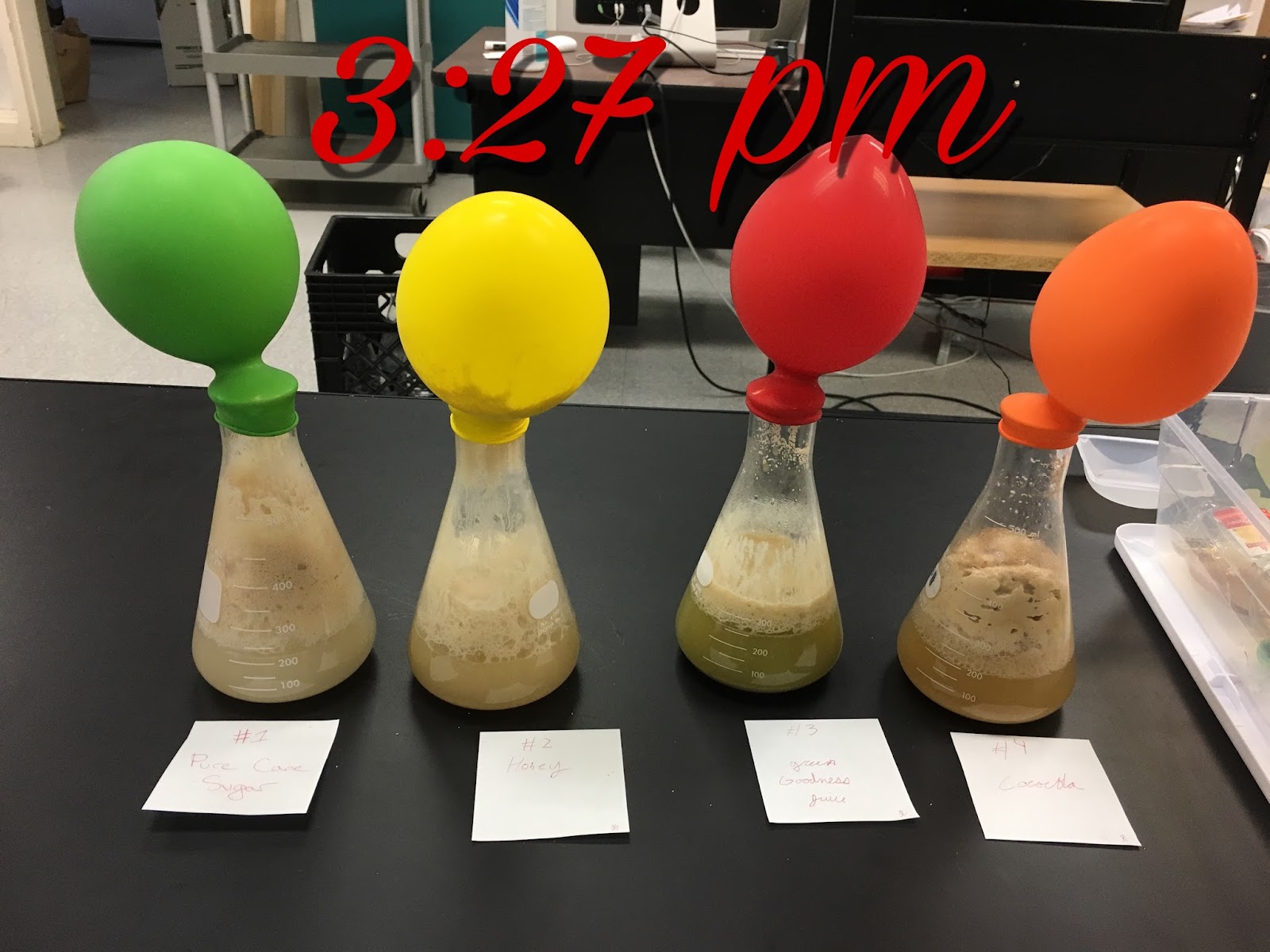
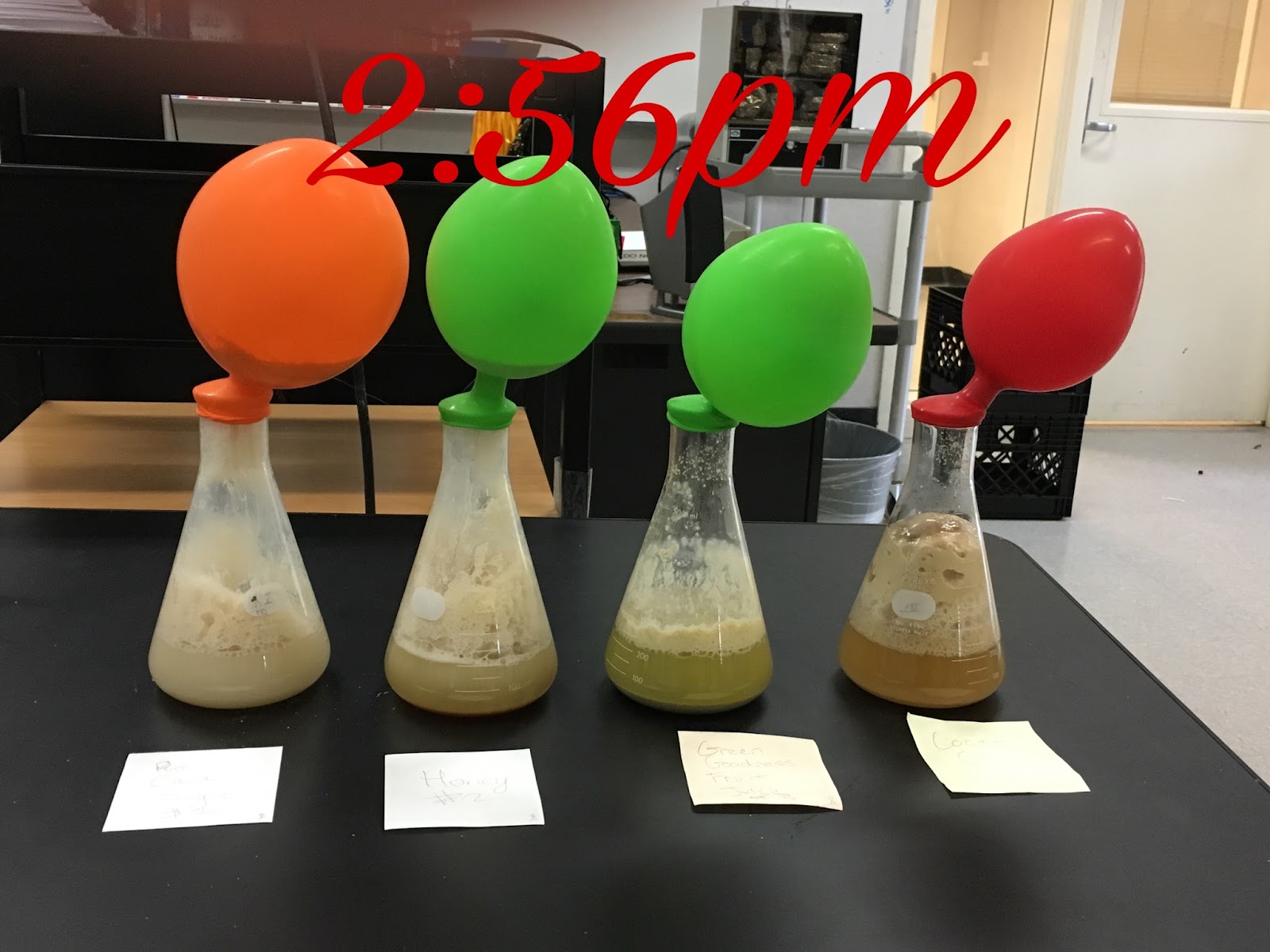
Here is the First Trial Results. Below is a time lapse of the whole experiment:

{"total_effects_actions":0,"total_draw_time":0,"layers_used":0,"effects_tried":0,"total_draw_actions":0,"total_editor_actions":{"border":0,"frame":0,"mask":0,"lensflare":0,"clipart":0,"text":0,"square_fit":0,"shape_mask":0,"callout":0},"effects_applied":0,"uid":"39AFAD67-0DD4-4937-A6C1-C2BECCE0C0FD_1477530115166","width":3344,"photos_added":0,"total_effects_time":0,"tools_used":{"tilt_shift":0,"resize":0,"adjust":0,"curves":0,"motion":0,"perspective":0,"clone":0,"crop":0,"enhance":0,"selection":0,"free_crop":0,"flip_rotate":0,"shape_crop":0,"stretch":0},"source":"editor","origin":"gallery","height":2508,"subsource":"done_button","total_editor_time":73,"brushes_used":0}


The Second Trial:


{"total_effects_actions":0,"total_draw_time":0,"layers_used":0,"effects_tried":0,"total_draw_actions":0,"total_editor_actions":{"border":0,"frame":0,"mask":0,"lensflare":0,"clipart":0,"text":0,"square_fit":0,"shape_mask":0,"callout":0},"effects_applied":0,"uid":"39AFAD67-0DD4-4937-A6C1-C2BECCE0C0FD_1478803771861","width":3344,"photos_added":0,"total_effects_time":0,"tools_used":{"tilt_shift":0,"resize":0,"adjust":0,"curves":0,"motion":0,"perspective":0,"clone":0,"crop":0,"enhance":0,"selection":0,"free_crop":0,"flip_rotate":0,"shape_crop":0,"stretch":0},"source":"editor","origin":"gallery","height":2508,"subsource":"done_button","total_editor_time":23,"brushes_used":0}


Third Trial: 


{"total_effects_actions":0,"total_draw_time":0,"layers_used":0,"effects_tried":0,"total_draw_actions":0,"total_editor_actions":{"border":0,"frame":0,"mask":0,"lensflare":0,"clipart":0,"text":0,"square_fit":0,"shape_mask":0,"callout":0},"effects_applied":0,"uid":"39AFAD67-0DD4-4937-A6C1-C2BECCE0C0FD_1478804683306","width":3344,"photos_added":0,"total_effects_time":0,"tools_used":{"tilt_shift":0,"resize":0,"adjust":0,"curves":0,"motion":0,"perspective":0,"clone":0,"crop":0,"enhance":0,"selection":0,"free_crop":0,"flip_rotate":0,"shape_crop":0,"stretch":0},"source":"editor","origin":"gallery","height":2508,"subsource":"done_button","total_editor_time":41,"brushes_used":0}


This is the data table of all the trials we did and what our results were. None of the results were entirely consistent except for the Coca-Cola.


Amount of CO2 Circumference of Balloon (inch)

Amount of CO2
Circumference of Balloon (inch)

Amount of CO2
Circumference of Balloon (inch)

Type of sugar:
PH Levels
Test 1:

Test 2:
Test 3:
Pure Cane Sugar (mL)
pH 6
12
14.5
17
Honey (mL)
pH 8
12
12
8.5
Coca-Cola
pH 1
11
11
11
Green Goodness Bolthouse Farms Juice (mL)
pH 5
12
12
10.5


  • The independent variable, or the x variable, is the different sugars we gave to the yeast; the added sugars in Coca-Cola, the natural sugars in Green Goodness Juice, Pure Cane Sugar and Honey.
  • The dependent variable, or Y variable, was determined by the amount of CO2 that was exhaled out by the yeast. To determine this, we measured the circumference of each balloon and the height of the foam in each flask.


To tie loose ends together, the yeast survived the best in pure cane sugar in the control sugars, and the yeast in the juice did better than the yeast in the Coca-Cola. In the control groups, sugar always did better than honey, but that’s because honey is largely concentrated with sugar and too much sugar is bad for the yeast. The Coca-Cola stayed at the same amount of carbon, at an 11 inch circumference. The Green Goodness Juice usually stayed above that range at a 12 inch circumference, other than the final trial. Overall, this means that the most effective was the cane sugar, probably because it fits the perfect conditions for yeast or any organism to easily digest it, but those results weren’t the most impressive. The results that stand out are the Coca-Cola and the Green Goodness Bolthouse Farms Juice. The juice almost always was more effective than the Coca-Cola, which shows that the natural sugars were more beneficial to the yeast than the soda, but it might also be due to the fact that the Coca-Cola had a ph acidity level of 1, an incredibly high acidity. Either way, the results concluded that the natural sugars of the juice were much more beneficial than the added sugars of the soda.

            The hypothesis that Group #2 generated was that the juice would breathe out more carbon. While this isn’t true if you take in account the two controls, it is true when comparing it to the soda, which shows that added sugars are not as beneficial as regular sugars. Also, the are some tweaks that the group could have done to make the experiment better. They kept on running out of certain materials and the replacements weren’t of the same quality. This can be said about the honey, yeast and juice. Yeast also only intakes sugar, while humans find many other benefits to foods with natural sugars because they are found in foods with nutrients that are beneficial for the human body. If they were to do this experiment again, they would use Splenda instead of honey, since it is just too much sugar, and they would get enough materials to last all three trials. The results are somewhat conclusive because the group did three trials to be safe. The soda results were consistent at 11 inches and almost always were under all the other sugars. The honey was the least conclusive, since its sugar content is much higher than the others and they kept on running out of the same type of honey, yet they stayed consistent in two of the trials at 12 inches, the same as the other natural liquid, the juice. If someone were to replicate this experiment, they would get nearly the same results in the drink categories because they were the least likely to change results with each trial. The sugar was merely a control, and the results of that were the most spontaneous since the trials had a range of 12 to 17 inches. All in all, the results of this lab with yeast display that natural sugars, that were not added, are the most beneficial to life forms because of their nutritional content. The American People should note that their sweetness shouldn’t have to be added to their meals, but instead derive from the natural fruits and plants that are given to them from nature, and it will effectively be better for them, even going as far as keeping them from getting heart disease.

Works Cited:

Corliss, Julie. "Eating Too Much Added Sugar Increases the Risk of Dying with Heart Disease - Harvard Health Blog." Harvard Health Blog RSS. N.p., 2015. Web. 14 Nov. 2016.

Gallup, Inc. "Nearly Half of Americans Drink Soda Daily." Gallup.com. N.p., 2012. Web. 14 Nov. 2016.

"How Does Sugar Affect Yeast Growth?" How Does Sugar Affect Yeast Growth?N.p., n.d. Web. 14 Nov. 2016.