Showing posts with label nutrition. Show all posts
Showing posts with label nutrition. Show all posts
Monday, November 21, 2016
Iron Chef Competition
Today we watched the presentations of the other iron 'chef' group lab experiments. Each team had different items depending on what they picked. Each team had to come up with a hypothesis, a procedure, a purpose, and etc. Every two teams were competing with the same ingredients.
We started with the fresh strawberries groups.
Team 1: They used enzymes to digest down strawberries. They tested to see what kind of strawberry would digest the fastest. They dropped both conventional and organic strawberries in amylase, pectinase, and mixtures of the two. They put strawberries in beakers of water, pectinase, amylase and the mixture then measured the displacement. There were a couple of problems however, evaporation was greater in some beakers than others, the marks weren't precise enough, light got into the beakers to cause more evaporation, there weren't enough strawberries, some beakers were different sizes, the measuring tools weren't precise, there was even mold growth, and increased the displacement. Disregarding evaporation, there wasn't any difference in between conventional and organic digestion. They were originally testing to see how conventional and organic food would digest, but there was no visible difference.
vs.
Team 2: This team tested to see which grew more mold (betridus cinerea), conventional or organic strawberries. They made agar to put the strawberries in. They used regular agar and potato dextrin agar. They swabbed the strawberries, opened the petri dish and spread it across the agar. They kept the agar in the incubator for two weeks. Then they stained the petri dish so they could see the mold growth. They looked for gram negative and gram positive microbes in the dishes. Their timing was a bit off, their incubator got turned off for a day, they didn't have a strong microscope and they didn't always wear gloves. If they were to do it again they would wait longer for the fungus to grow.
(Team 2 Moved on to the next round!)
Pesticides
Team 1: They tested different amount of pesticides to see which affected animal or plant cells more. They used yeast because it acts as an animal cell, they activated for about 10 to 15 minutes, then added sugar and pesticide once every two days for two weeks. The yeast with pesticide died, while the ones with pesticide stayed alive as they added the sugar. An error was that ants got into the classroom. Then they tested against basil to see if the pesticide affected plants. 3 had pesticide, and the one without pesticide. The ones with pesticide started drying out and the leaves started breaking off easily. The pesticide did affect the plants. It was the only one with ta positive increase, the rest had a decrease. They measured by height. The main purpose of the experiment was to see how pesticides affect the food people eat and the animal cells that humans have. The judge felt like there should have been more control groups, and show the change of height and not just the overall height.
vs.
Team 2: Their hypothesis was to see if organic or conventional grew more bacteria after having pesticide put on them. They made agar then got their two materials. They got organic chuck meat and conventional chuck meat and organic and non-organic apples. It lasted two weeks with a total of five collection days. Sometimes there was mold on the agar groups, sometimes there wasn't anything especially in the control groups. Their basic reason for this experiment was that conventional is usually covered in pesticides. Organic is not allowed to have more than .1% pesticide. The incubator was turned off for a day also. The organic chuck was the one that stunk up the room the most. Ants started coming into the room. They weren't able to check the dishes every day. The incubator overheated near the end of the experiment. If they were to do it again they would use more dishes so they had more groups to check for more growth. They would measure more and they would work in a more controlled environment.
(Team 1 Moved on to the next round! )
Sugars
Team 1: This group swabbed sugars to see how bacteria acts after being fed different sugars. The overarching goal was to relate the bacteria growth is like cell growth. They put a different sugar in each petri dish. They wanted to see which one promoted the most cell growth. First, they had to make the agar. They used agar tablets, a hot plate, distilled water, a beaker, and a heat protecting glove. They used bacteria from the back of phones and then observe how the bacteria grew with different sugars. They counted the amount of bacterial colonies and averaged out three counts, then averaged out all the times. They used honey, cane sugar, corn syrup and a control group.
vs.
Team 2: This team used the sugars to test for glucose levels in the human body. They picked out their human subjects. Every core day they would test and monitor blood. They pricked fingers to test blood. They started with a week to see their regular blood sugar level. Each week they tested out a different sugar, from cane sugar to honey to corn syrup. They then found the averages of the sugar. Honey had the highest increase in blood sugar levels. There were some holes in their data. If they were to do it again, they would do it for longer and with more people.
(Team 1 Moved on to the next round! )
Corn
Team 1: They began by talking about BPA. It is a chemical found in plastic containers and the inside of cans. BPA would be found in most of the ingredients the group was given. BPA is toxic and can hurt cells. They extracted BPA straight from a plastic water bottle. They worked with the A.P. Chem teacher to do this. BPA has a significant lower melting rate than plastic so they were able to melt out the BPA. They wanted to see differences in between the BPA cells and the control groups. They weren't able to get conclusive results but they learned a lot about how to make an experiment and how to make BPA. BPA is a toxic chemical and the group learned to avoid letting plastic melt that can have BPA because it can cause cancer and other diseases.
vs.
Team 2: They tested to see how bacteria grew on different types of corn. They learned how to use a microscope. Then they learned how to make their own agar. Then they learned how to count colonies electronically. They ran it through a program by masking the image then tracked the amount of colonies. They swabbed bacteria from surfaces then covered the corn with it. They took pictures of them every core day, a total of six days. There were some errors. The colony counting was messed up first. The petri dishes weren't sterilized. The incubator was turned off one day so that skewed the results. The incubator dried up the agar at one point. Frozen corn killed the most bacteria and the conventional corn gathers a lot of bacteria and grows the most. They consider frozen corn to be the best choice for people with autoimmune disorders and its better for the world so that they can eat healthier non-frozen food.
(Team 1 Moved on to the next round!)
Team 1: The first team put teeth into the different drinks. They saw how each of the teeth decayed and grew plaque in the different drinks.
Team 2: Our team, so check out this post to see more.
(Team 2 Moved on to the next round! Yay!)
And after one final round, the winner is the Corn team that melted BPA from plastic. Good job everybody!

Tuesday, November 15, 2016
Iron Chef Lab: Do Added Sugars Matter?
“Nearly half of Americans, 48%, report drinking at least one glass of soda per day, while 52% say they normally drink no soda. Among those who drink any soda, the average daily amount is 2.6 glasses, with 28% drinking one glass a day, on average, and 20% drinking two or more glasses” (Saad, Lydia, Gallup). This is all despite the fact that soda is full to the brim with added sugars, which are attributed to high blood pressure and heart disease (Corliss, Julie, Harvard Health). Children and young adults are the ones who derive most of their sugar from soda, which is a major concern for the next generation’s health(Saad, Lydia, Gallup). The question is, are added sugars actually worse than naturally occurring sugars such as in fruit and honey? To test this, Iron Chef Lab Group #2 tested to see how yeast, a fungi organism, reacted to added sugars versus natural sugars. Yeast feeds on sugar, and according to prior research of how yeast reacts to sugars, they could test for growth by measuring the amount of carbon they respirate. The stronger the sugar, the more the yeast would grow except with some exceptions such as honey, since it is such a strong sugar (Hewitson, John, Hill, Charles, How does sugar affect yeast growth?). The hypothesis was that yeast requires sugar to survive, but if it is given added sugar, it will not live as well as if it were given natural sugars. Essentially, the added sugars of a soda will have less of an effect than the natural sugars found in fruit drinks or natural sources such as honey.
These are the materials we used in the process of this lab:
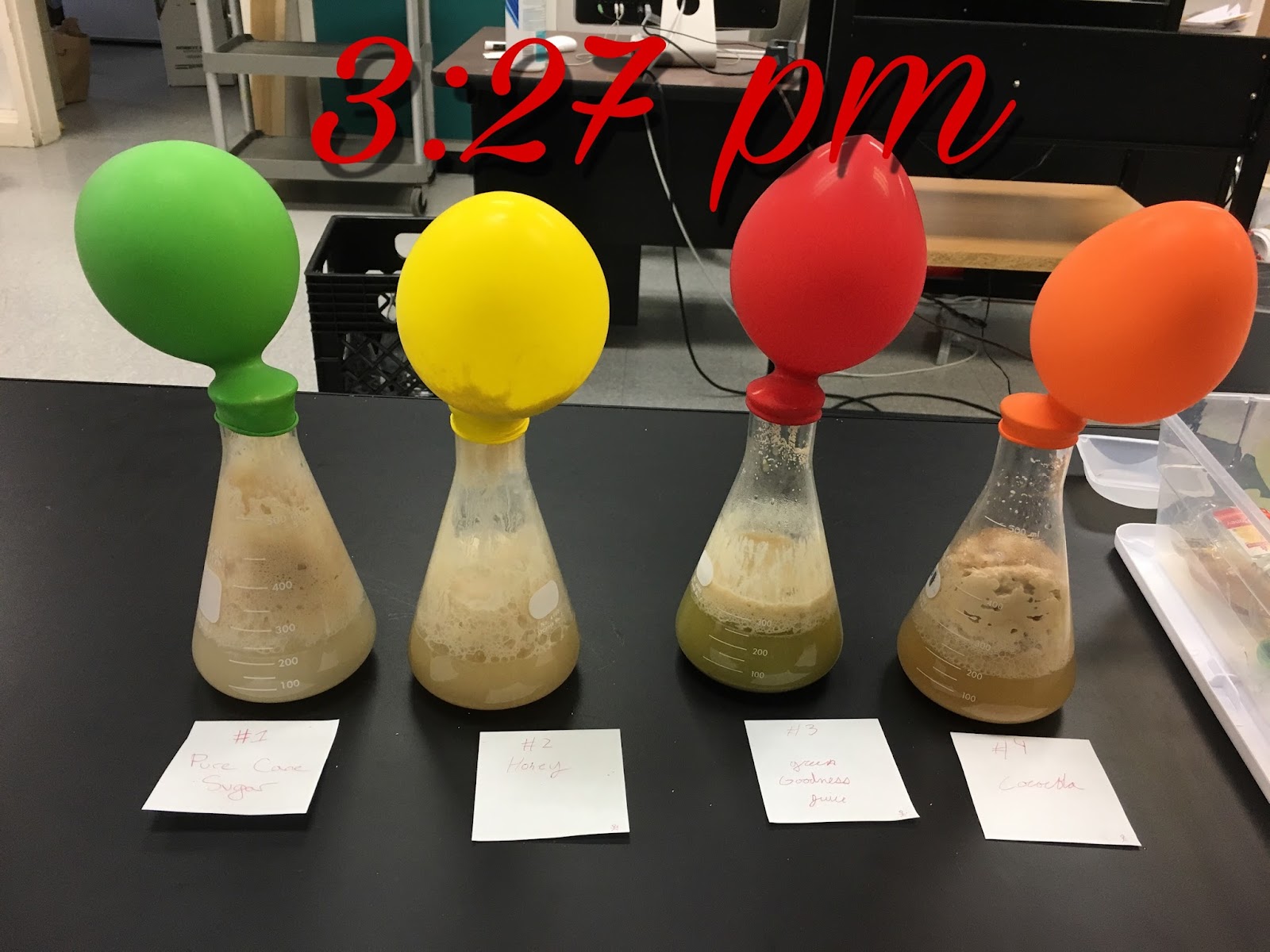
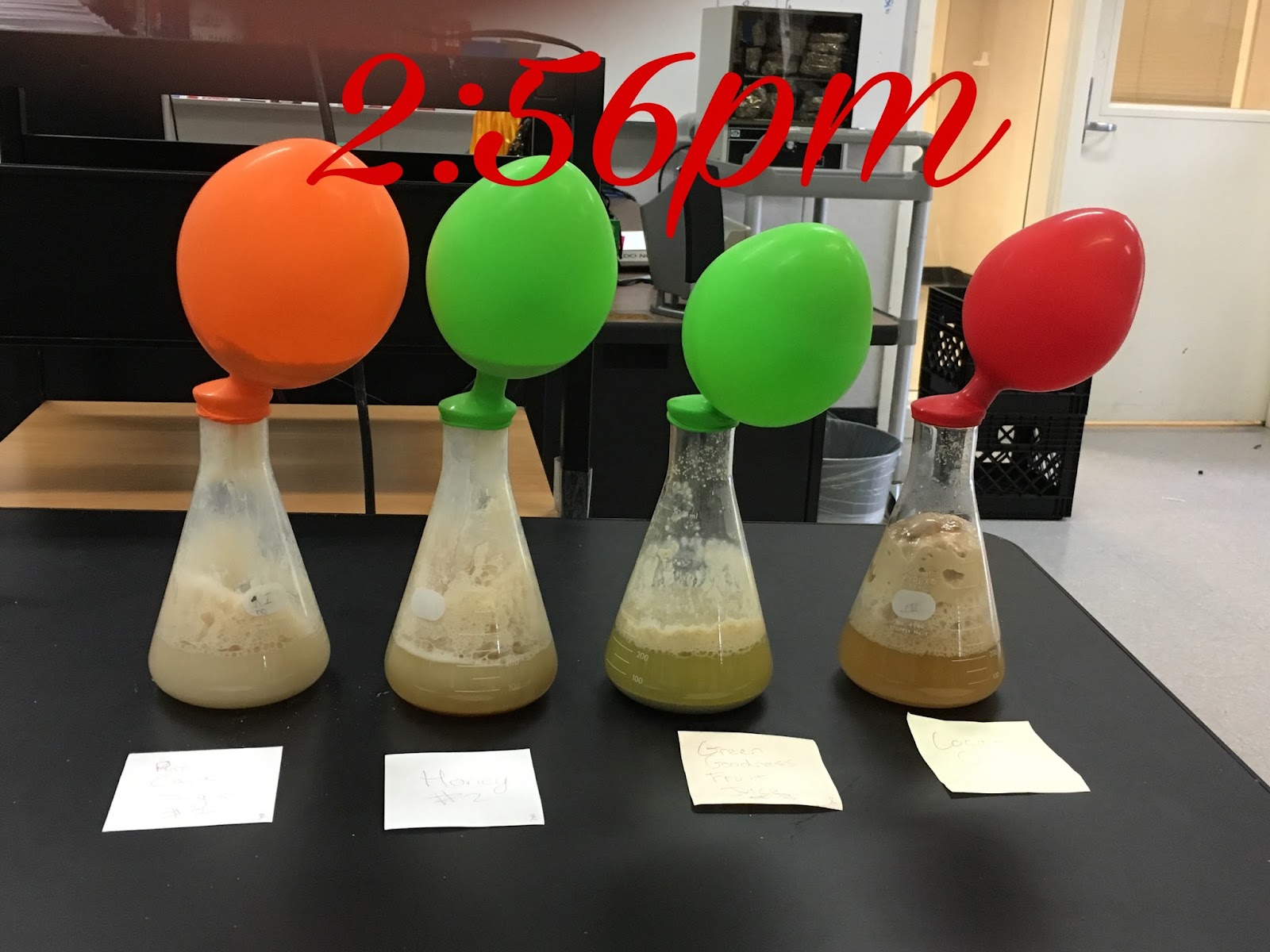


These are the materials we used in the process of this lab:
50 ml Coca-Cola
50 ml Green Goodness Bolthouse Farms Juice
50 ml Pure Cane Sugar
50 ml Honey
5 beakers with 2000 ml of 110॰ water
8 flasks in ml
4 balloons
5 packets (each being ¼ of an ounce/ 2 ¼ teaspoons) of yeast
pH strips
Measuring tape (in inches)
Labels
The steps we took to make the lab:
1.) Fill all 5 beakers with 200 ml of room temperature water and label each.
2.) Then add 50 ml of coca-cola to beaker #1, add 50 ml of Green Goodness Bolthouse Farms Juice to beaker #2, add 50 ml of Pure Cane Sugar to beaker #3, add 50 ml of Splenda to beaker #4, and 50 ml of Honey in beaker #5.
3.) Add one packet of yeast ( ¼ of an ounce/ 2 ¼ teaspoons) to each balloon. Attach a balloon to each beaker without letting the yeast drop into the liquid.
4.) Let the yeast drop into the liquid at the same time.
5.) Observe the beakers every 15 minutes until the results are quantifiable (about 1 to 2 hours).
6.) Record your results by tying the balloons and measuring the diameters of each with a measuring tape.
This link leads to a video of us pouring living yeast into the beakers, all at the same time.
Here is the First Trial Results. Below is a time lapse of the whole experiment:
The Second Trial:
Third Trial:
This is the data table of all the trials we did and what our results were. None of the results were entirely consistent except for the Coca-Cola.
Amount of CO2 Circumference of Balloon (inch)
|
Amount of CO2
Circumference of Balloon (inch)
|
Amount of CO2
Circumference of Balloon (inch)
| ||
Type of sugar:
|
PH Levels
|
Test 1:
|
Test 2:
|
Test 3:
|
Pure Cane Sugar (mL)
|
pH 6
|
12
|
14.5
|
17
|
Honey (mL)
|
pH 8
|
12
|
12
|
8.5
|
Coca-Cola
|
pH 1
|
11
|
11
|
11
|
Green Goodness Bolthouse Farms Juice (mL)
|
pH 5
|
12
|
12
|
10.5
|
- The independent variable, or the x variable, is the different sugars we gave to the yeast; the added sugars in Coca-Cola, the natural sugars in Green Goodness Juice, Pure Cane Sugar and Honey.
- The dependent variable, or Y variable, was determined by the amount of CO2 that was exhaled out by the yeast. To determine this, we measured the circumference of each balloon and the height of the foam in each flask.
To tie loose ends together, the yeast survived the best in pure cane sugar in the control sugars, and the yeast in the juice did better than the yeast in the Coca-Cola. In the control groups, sugar always did better than honey, but that’s because honey is largely concentrated with sugar and too much sugar is bad for the yeast. The Coca-Cola stayed at the same amount of carbon, at an 11 inch circumference. The Green Goodness Juice usually stayed above that range at a 12 inch circumference, other than the final trial. Overall, this means that the most effective was the cane sugar, probably because it fits the perfect conditions for yeast or any organism to easily digest it, but those results weren’t the most impressive. The results that stand out are the Coca-Cola and the Green Goodness Bolthouse Farms Juice. The juice almost always was more effective than the Coca-Cola, which shows that the natural sugars were more beneficial to the yeast than the soda, but it might also be due to the fact that the Coca-Cola had a ph acidity level of 1, an incredibly high acidity. Either way, the results concluded that the natural sugars of the juice were much more beneficial than the added sugars of the soda.
The hypothesis that Group #2 generated was that the juice would breathe out more carbon. While this isn’t true if you take in account the two controls, it is true when comparing it to the soda, which shows that added sugars are not as beneficial as regular sugars. Also, the are some tweaks that the group could have done to make the experiment better. They kept on running out of certain materials and the replacements weren’t of the same quality. This can be said about the honey, yeast and juice. Yeast also only intakes sugar, while humans find many other benefits to foods with natural sugars because they are found in foods with nutrients that are beneficial for the human body. If they were to do this experiment again, they would use Splenda instead of honey, since it is just too much sugar, and they would get enough materials to last all three trials. The results are somewhat conclusive because the group did three trials to be safe. The soda results were consistent at 11 inches and almost always were under all the other sugars. The honey was the least conclusive, since its sugar content is much higher than the others and they kept on running out of the same type of honey, yet they stayed consistent in two of the trials at 12 inches, the same as the other natural liquid, the juice. If someone were to replicate this experiment, they would get nearly the same results in the drink categories because they were the least likely to change results with each trial. The sugar was merely a control, and the results of that were the most spontaneous since the trials had a range of 12 to 17 inches. All in all, the results of this lab with yeast display that natural sugars, that were not added, are the most beneficial to life forms because of their nutritional content. The American People should note that their sweetness shouldn’t have to be added to their meals, but instead derive from the natural fruits and plants that are given to them from nature, and it will effectively be better for them, even going as far as keeping them from getting heart disease.
Works Cited:
Corliss, Julie. "Eating Too Much Added Sugar Increases the Risk of Dying with Heart Disease - Harvard Health Blog." Harvard Health Blog RSS. N.p., 2015. Web. 14 Nov. 2016.
Gallup, Inc. "Nearly Half of Americans Drink Soda Daily." Gallup.com. N.p., 2012. Web. 14 Nov. 2016.
"How Does Sugar Affect Yeast Growth?" How Does Sugar Affect Yeast Growth?N.p., n.d. Web. 14 Nov. 2016.
Friday, October 28, 2016
Unit 1: Nutrition Assessment
Emily Gonzalez
10th Grade
Neto
Tucker
N.E.W. School
10/27/16
Unit 1: Nutrition Assessment
The implications that food has on health, the economy, ecology, and the community is a subject that is rarely touched on in public high schools for more than a week in a health class. Except in N.E.W. (Next Evolution in Work Based Learning) School. Over the course of two months, I have learned about the chemical processes that organisms go through to make food into energy, the implications of industrial and organic foods, and the current research that is going into the
The chemical processes within cells that organisms cycle through every day are called cellular respiration (animals) and photosynthesis (plants) (Some fungi go through both or part of these processes). The first cycle we learned about was cellular respiration, which converts glucose, or sugar, into ATP, adenosine phosphate. To be able to go through this process in an animal though, food has to be digested by going through the digestive system. To represent this, NEW school used tubes and food to simulate the process of digestion. The digestive system breaks down food with both physical energy (mastication and stomach churning) and chemical enzymes, such as amylase in saliva or lipase and lactase in the intestine. The small intestine absorbs all of the nutrients, then the small intestine and rectum get rid of the waste.


Here is NEW learning about the digestive system by making a model of it with scissor and cup teeth, nylon intestines and plastic bag stomachs.
With only the nutrients left, sugar then goes into the cells to start the cellular respiration process. We learned this through the allegory of converting a cake mix (to represent sugar) into muffins (ATP). In cellular respiration, the cytoplasm organelle of the cell breaks glucose molecules into half, also known as pyruvate, then the mitochondria puts the pyruvate into the Krebs cycle, which creates hydrogens that go through the Electron Transport Chain, thus turning into ATP. Everything past glycolysis requires oxygen from the lungs to function. Photosynthesis is the opposite, turning sunlight and carbon dioxide into glucose and oxygen. So plants and animals depend on each other. The plants create the glucose for them to function, and breathe out oxygen that animals need. Humans, or the animals they eat, eat the plants that have the glucose they need to convert into ATP.

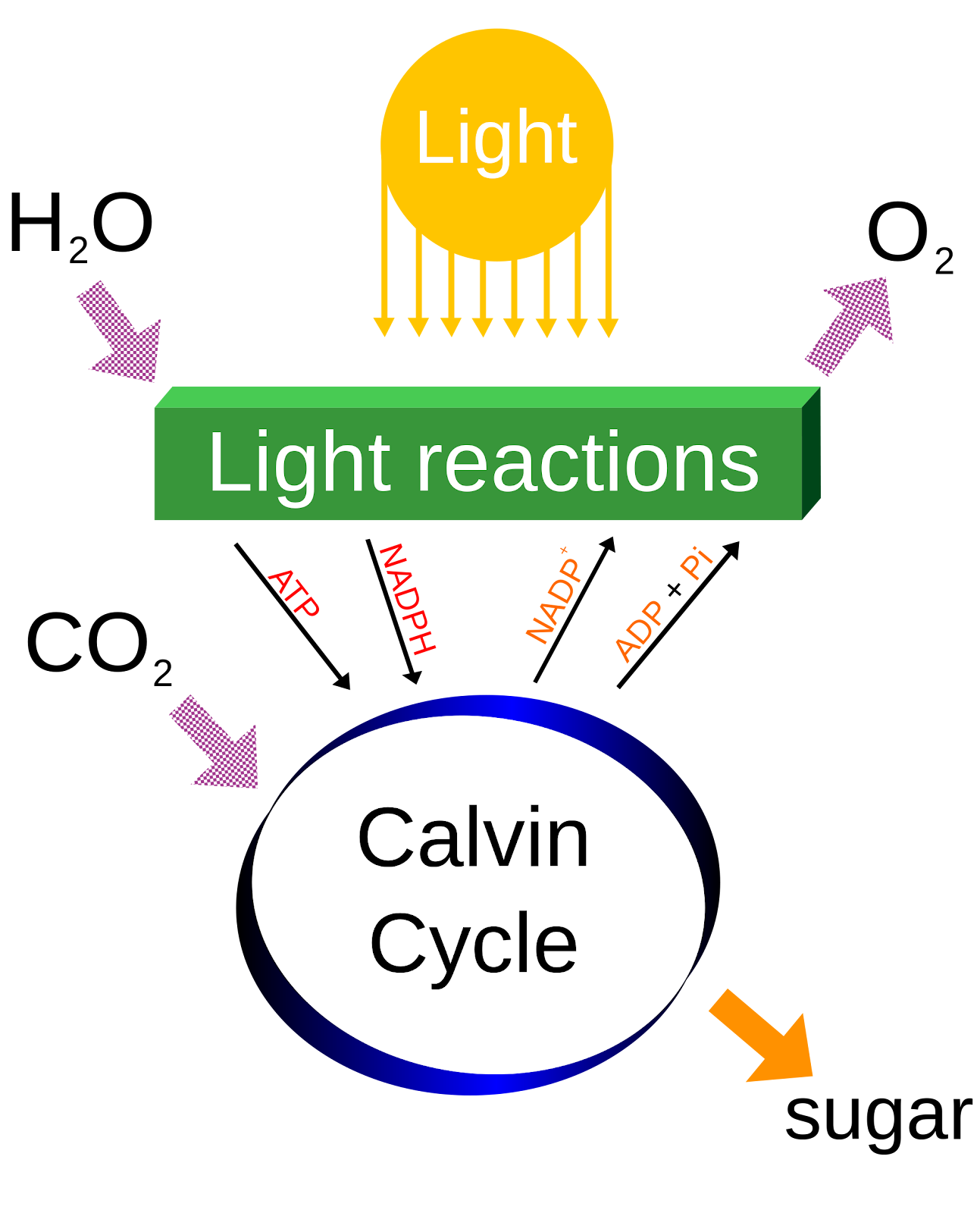
The process of cellular respiration in an animal cell
The process of converting sunlight into glucose - photosynthesis in a plant cell
After learning about the science that goes into bodies using food to make energy, I could better understand the implications that different food has on a person’s health. As omnivores, humans were able to live and thrive anywhere, but since humans have existed, they have encountered a dilemma. The dilemma of knowing what we should eat, versus what will kill us. Humans still encounter this today, in the aisles of the grocery store. Everything that they buy can have larger implications towards their community, their overall health, the environment and ethics. Through the process of reading Omnivore’s dilemma, I have learned about what goes into industrial food, and how it is ultimately unsustainable. It is all built on “a single species growing in a single landscape: a monoculture of corn” (Pollan, Michael, “The Omnivore’s Dilemma”, pg. 410). With the giant industry of number 2 corn in America, grown only for the use of chemicals, the United States has put it in everything, from cleaning supplies, to frozen dinners, to salmon, to beef, and to anything that went through a factory. Corn in the forms it is transformed to might not even be digestible. Organic food is only so much better. Yes, it isn’t always filled to the brim with corn, but just because something has the USDA approved organic label doesn’t mean that is is truly sustainable. They still use up a large amount of fossil fuels to ship across the country. To keep their animals healthy, they usually have to lock them up in cages, which is the opposite of what consumers want. The only truly sustainable foods are local, naturally raised foods, which also pose a problem for people in areas where that is not possible. So, overall, all food has different implications on everything, and it is up to the consumer to decide what they want to support and what they want to put into their bodies.
While researching for the final unit project, I have learned about the necessary nutrients that people need to survive and how different diets affect people. For our final unit project, my partner and I discussed about the movie Forks over Knives, and then went into further detail about vegan and non-vegan diets. We also contacted two nutritionists to learn more about the topic. Through these interviews and research, I learned about nutrients that are necessary for the human body. Both of the nutritionists agree that every person’s best diet isn’t always the same, but it is good to eat whole foods such as vegetables, whole grains, fruits, beans, and possibly even milk and meat. Some people are affected differently by the same foods, so as long as you get the correct amount of nutrients and not eat things that are unnatural, or too much, then you will be healthy. Protein, Vitamin B-12 and Omega-3’s were all nutrients that my partner and I agreed were necessary, but could get from different sources. It all depends on a consumer’s choice of cuisine and culture.
(Here is a link to our Podcast if you want to learn more about this subject: https://soundcloud.com/emily-gonzalez-506558984/tracks)
To wrap things all together, this unit I learned why and how organisms digest food, how the food a consumer buys affects both the economy and health of the consumer and the nation, that it doesn’t matter what diet you are on as long as you are eating whole foods and getting the proper amount of nutrients. Nutrition is an important subject to learn, especially in this epidemic of health-related diseases. It is a subject that students should learn more about so that they can make the right decisions when they are older, and it is a subject that I am glad I learned in this new method of project based learning.
Thursday, October 27, 2016
Hold Your Forks and Knives Podcast
For our N.E.W. class final unit project on nutrition, my partner Isabella Lacefield and I made a podcast talking about the documentary Forks over Knives and vegan versus non-vegan diets. Our podcast is split into two parts, the first talking about the movie and the pros of each diet, and the second having two interviews with nutritionists and cons of each of the diets.
Part 1: Hold Your Forks and Knives
Part 2: Hold Your Forks and Knives
The conclusions we made after the talk were that it doesn't matter if you are vegan or anything else, as long as you are eating whole, non-processed foods and eating the proper amount of nutrients. Never get all of your information from one source, and talk to a nutritionist before changing diets.
Part 2: Hold Your Forks and Knives
The conclusions we made after the talk were that it doesn't matter if you are vegan or anything else, as long as you are eating whole, non-processed foods and eating the proper amount of nutrients. Never get all of your information from one source, and talk to a nutritionist before changing diets.
Subscribe to:
Posts (Atom)