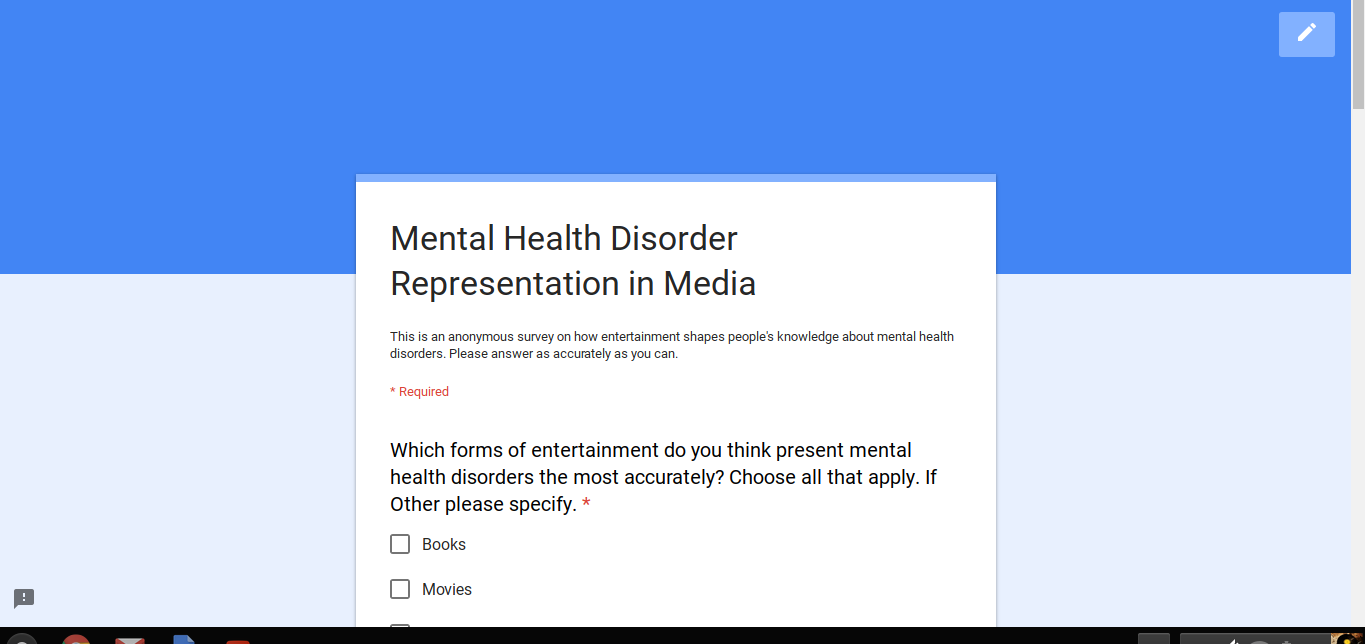
The N.E.W. Social Media Campaign has been moving along rather quickly, but that doesn't mean we haven't made significant process. I have had several differing responses from my survey (here).
I have discussed the project with Mr. Kinunen, a teacher at my high school.
We had a very interesting discussion about how representation in entertainment is lacking but has been significantly improving as time passes.
Check out the website for the upcoming A.P. Trash Theory podcast project, and sign up for bi-monthly podcasts. As part of the Social Media Campaign, I will also be hosting a blog that looks at different books, movies, TV shows, comics etc and rates them depending on how well they represent characters' mental illnesses depending on research conducted through primary interactions. You should also follow our twitter @APTrashTheory.
Later on, I will discuss more about autism, depression, and anxiety with other experts in these topics. I hope to better learn about Mental Health as a whole to help me educate others who have misconceptions on the topic.
Friday, May 12, 2017
Blood Typing Lab
Depending on the blood type you have, you will have a different antigen.
O: No antigens
A: A antigens
B: B antigens
AB: A and B antigens
If you get a blood transfusion and you have O blood, you couldn't mix with A because the A antigens would attack the O blood. You could give O to anything, it is a universal donor since O has no antigens. AB is a universal recipient because it can use both A antigens and B antigens.

Mrs. Neto did a demo for us to show how the different blood types can or cannot be mixed. For example, the clear water (O) can't have A or B added to it, but it can add to A or B. Think of the colors as the antigens, so the AB can take everything in because it has both blue and yellow to create green.
Rh is a type of protein on the outside of red blood cells. If there is Rh present, it is positive blood. If Rh is not present, it is negative blood.
Here is a table of the different blood types and the antigens and Rh need to be present:
The next thing we did was test our own blood to find out what type it is. If the blood has a reaction to the Anti-antigen, then it means that antigen is present.

After getting my finger pricked, Mrs. Neto put one drop of blood in each anti-antigen, and we stirred the mixture to see if there was a reaction.

Here is the table of how my blood reacted to the anti-antigens.
According to the results, I have an A+ blood type. This means that I can donate to other people with A+ blood and other people with A+, A-, O+ and O- blood can give me blood.
O: No antigens
A: A antigens
B: B antigens
AB: A and B antigens
If you get a blood transfusion and you have O blood, you couldn't mix with A because the A antigens would attack the O blood. You could give O to anything, it is a universal donor since O has no antigens. AB is a universal recipient because it can use both A antigens and B antigens.
Mrs. Neto did a demo for us to show how the different blood types can or cannot be mixed. For example, the clear water (O) can't have A or B added to it, but it can add to A or B. Think of the colors as the antigens, so the AB can take everything in because it has both blue and yellow to create green.
Rh is a type of protein on the outside of red blood cells. If there is Rh present, it is positive blood. If Rh is not present, it is negative blood.
Here is a table of the different blood types and the antigens and Rh need to be present:
Blood Type
|
Antigen A
(Present)
|
Antigen B
(Present)
|
Rh
(Present)
|
O+
|
No
|
No
|
Yes
|
A+
|
Yes
|
No
|
Yes
|
B+
|
No
|
Yes
|
Yes
|
O-
|
No
|
No
|
No
|
A-
|
Yes
|
No
|
No
|
AB+
|
Yes
|
Yes
|
Yes
|
B-
|
No
|
Yes
|
No
|
AB-
|
Yes
|
Yes
|
No
|
The next thing we did was test our own blood to find out what type it is. If the blood has a reaction to the Anti-antigen, then it means that antigen is present.
After getting my finger pricked, Mrs. Neto put one drop of blood in each anti-antigen, and we stirred the mixture to see if there was a reaction.
Here is the table of how my blood reacted to the anti-antigens.
Trial
|
Reaction with Anti-A (Y/N)
|
Reaction with Anti-B (Y/N)
|
Reaction with Anti-Rh
|
Determined Blood Type
|
Emily
| Yes | No | Yes | A+ |
According to the results, I have an A+ blood type. This means that I can donate to other people with A+ blood and other people with A+, A-, O+ and O- blood can give me blood.
Planning a Solution - Social Media Campaign
Every problem has more than one solution, and every problem is a set of smaller problems each with their own solutions. That's why Mrs. Neto had the people in the Social Science Groups devise a plan to tackle their large problem by having us go through a Design Thinking process. We had to write out all the problems that lead into the larger problem on an easel, then group them together to see how many we could tackle with the same solution. My easel looked like this:
My problem is how mental health issues are represented in entertainment such as movies or TV shows. I came up with several reasons why storytellers decide to portray their characters in this way, and later discussed it specifically about movies with the film teacher here at my high school.
Thursday, May 4, 2017
Mental Health Representation in Media Survey
In N.E.W. school we are starting our final project, a social media campaign. All of us have to pick one of our four unit topics, nutrition, mental health, environment or social media, and do research and come up with a solution for a problem in one of those fields.
Here is the link to a Google Survey to conduct research on my topic which is mental health disorders and how they are presented in the media, more specifically entertainment. If you have any more comments or want to be personally interviewed, add contact info at the end of the survey.
These responses will be used for my project and as part of a discussion on my podcast A.P. Trash Theory. On our first episode we will discuss how mental health issues are portrayed in entertainment. It's a comedy series talking about 'trash' or our interests, and we will continue to update with new episodes every month or so. It will continue onto my junior year as my Junior Project.
Tuesday, May 2, 2017
What is a virus?
What is a virus?
| Avian Flu Virus |
A virus is a complex collection of living matter that is able to self-replicate.
What is the structure of a virus?

Virus infecting a cell
They are mostly a shell of protein that encases either DNA or RNA with enzymes for replication. They are a structure of genetic material, either DNA or RNA, called a genome.
How do viruses work?
The genome uses the power of other molecular machines to replicate itself but it cannot do this without infecting another cell. The virus uses its protein shell to bond with the membrane of the cell. This step affects which cells it can enter. Once it enters, it can hijack the protein-making system of the cell and use the cell’s DNA replication process to create viral proteins. These fill up the cell until it bursts, releasing the thousands of viral proteins to infect other hosts.
Viruses are everywhere and can be inhaled, ingested or can generally enter through any entrance into the body.
If a bacteria had eyes, even it would not be able to see a virus.
Viral Tag
In N.E.W. Science class, we played a game called Viral Tag to see how this process would look like to scale. The game was that one team was viruses, one team were blood cells and one group was regular cells. The viruses had to infect everyone in the group, so they had to tag the healthy cells. If no blood cell came to heal the cell, they would become a virus. This displayed how if a cell was infected by a virus, it would produce and release thousands of viruses that would infect other healthy cells. It could easily be seen that the more viruses there were compared to blood cells, the harder it was for the immune system to keep up.
| Virus infecting a cell |
How do viruses work?
The genome uses the power of other molecular machines to replicate itself but it cannot do this without infecting another cell. The virus uses its protein shell to bond with the membrane of the cell. This step affects which cells it can enter. Once it enters, it can hijack the protein-making system of the cell and use the cell’s DNA replication process to create viral proteins. These fill up the cell until it bursts, releasing the thousands of viral proteins to infect other hosts.
Viruses are everywhere and can be inhaled, ingested or can generally enter through any entrance into the body.
If a bacteria had eyes, even it would not be able to see a virus.
Viral Tag
In N.E.W. Science class, we played a game called Viral Tag to see how this process would look like to scale. The game was that one team was viruses, one team were blood cells and one group was regular cells. The viruses had to infect everyone in the group, so they had to tag the healthy cells. If no blood cell came to heal the cell, they would become a virus. This displayed how if a cell was infected by a virus, it would produce and release thousands of viruses that would infect other healthy cells. It could easily be seen that the more viruses there were compared to blood cells, the harder it was for the immune system to keep up.
Friday, April 28, 2017
What's in our vaccines?
Name of Vaccine
|
No. of Ingredients
|
Benign Ingredients
|
Toxic Ingredients
|
Limited info
|
Polio
|
9
|
Vero cells, M 199, calf bovine, phenoxyethanol, neomycin, Eagle MEM modified medium
|
Formaldehyde, streptomycin, polymoxin B
|
M-199
|
DTaP
|
15
|
Glutaraldehyde, Dimethyl-Beta-Cyclodextrin, Ammonium Sulfate, Aluminum Hydroxide and Polysorbate 80 (Tween 80)
|
All of them are toxic in high quantities.
|
Fenton medium containing a bovine extract, modified Latham medium derived from bovine casein, modified Latham medium derived from bovine casein
|
MMR 2
(Measles, Mumps, Rubella)
|
13
|
All
|
Only toxic if taken in high quantities: amino acids, vitamins
|
Chick embryo cell culture, W1-38 human diploid lung fibroblasts
|
HIB
|
12
|
Sodium Chloride, sucrose, saline, lactose
|
Modified Mueller and Miller Medium, Formaldehyde, lactose (if intolerant)
|
Synthetic Mediums, Amorphous Aluminum Hydroxyphosphate Sulfate
|
Hepatitis B
|
Yeast protein, mineral salts, dextrose, soy peptone,
|
Formaldehyde, Sodium Hydrogen Phosphate Dihydrate, Disodium Phosphate Dihydrate, Aluminum Hydroxide (when combined with kidney failure), Sodium Chloride
| ||
Hepatitis A
|
16
|
Formalin, MRC-5 human diploid cells, aluminum hydroxide
|
Sodium chloride, sodium borate, aminoglycoside antibiotics, neomycin
|
Amorphous Aluminum Hydroxyphosphate sulfate
|
Varicella (Chickenpox)
|
15
|
Sucrose, hydrolized gelatin
|
urea, neomycin, monosodium L-glutamate, sodium phosphate dibasic, potassium phosphate monobasic, potassium chloride, EDTA (Ethylenediaminetetraacetic acid)
|
Human embryonic lung cell cultures, guinea pig cell cultures, human diploid cell cultures (W1-38), human diploid cell
|
HPV
|
10
|
Vitamins, carbohydrates,
L-Histidine is a main amino acid needed in your body.
|
AAHS has been found to be a neurotoxin. Polysorbate 80 is toxic upon skin contact.
|
Sodium borate, mineral salts, vitamins,
|
Some questions that come to mind when looking at the table above are:
- Who researches these ingredients?
- What if someone has allergies to these ingredients?
- How many people experience side effects?
- How much is "toxic"? Consider age and weight.
Wednesday, April 26, 2017
Great TED Talks: Do Schools Kill Creativity?

What makes a great TED talk? To answer this question, I watched the most popular TED talk of all time, "Do Schools Kill Creativity" with speaker Ken Robinson.
This TED talk is the most popular TED talk of all time because it uses comedy to draw and interact with the audience and speaks about a subject that almost all people will relate to: education. Robinson is obviously greatly engaged with his audience, passionate about the topic of education and creativity. He proposes that a way to a better future is by changing our education system so that it reflects creativity and not being correct all the time. He uses anecdotes and jokes to keep his audience engaged and then uses those to transition into what he is there to talk about.
At the beginning, he just starts out with jokes and a hypothetical scenario. He uses jokes that people, especially ones in education, would relate to. Then he moves on by addressing his main points, balancing each with an anecdote that relates to it. He ends by stressing his message, comparing the problems of global climate change to the ever growing problems of our faulty education system.
Subscribe to:
Posts (Atom)